


I hope I'm not late for work!
 Jan 22, 2014 | 05:59 PM
#281

Thread Starter


Joined: Jan 2006
Posts: 16,282
Likes: 438
From: Huntsville, AL

I filled the exhaust port with water and found my smoking gun, thanks for that suggestion.

New exhaust valves should be here Friday.
I did notice something odd though, the engine has roughly an hour of idleing and maybe 5 minutes of driving on it. Cylinders 1,3, and 7 have noticeably more oil on them than cyl5. 5 also had the best leak down at only 9% (the others were 10-12%).
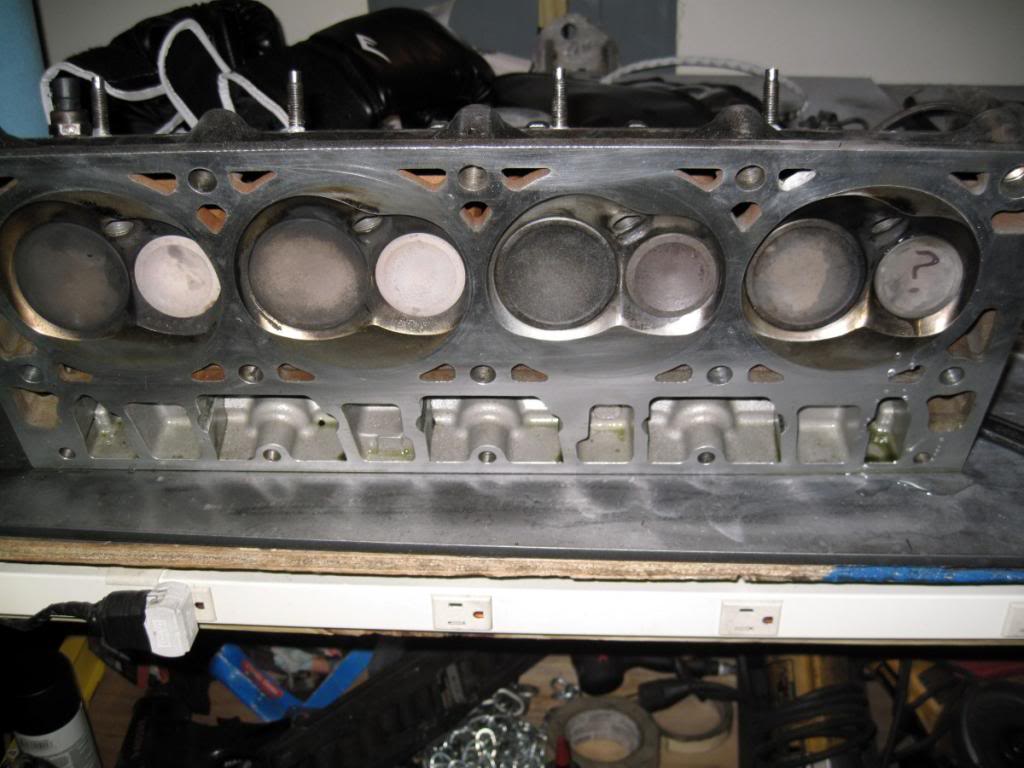
Just thought that was odd...

New exhaust valves should be here Friday.
I did notice something odd though, the engine has roughly an hour of idleing and maybe 5 minutes of driving on it. Cylinders 1,3, and 7 have noticeably more oil on them than cyl5. 5 also had the best leak down at only 9% (the others were 10-12%).

Just thought that was odd...
Jan 22, 2014 | 09:54 PM
#282
Thread Starter
Joined: Jan 2006
Posts: 16,282
Likes: 438
From: Huntsville, AL
Feb 3, 2014 | 11:03 AM
#283
Thread Starter
Joined: Jan 2006
Posts: 16,282
Likes: 438
From: Huntsville, AL
Had a local guy do a valve job on the heads with the new valves and also measure the chamber volume. Turns out they are a little smaller than I would like so just ordered some custom gaskets from cometic at 0.080" since this is my cheapest mediation. Compression should be around 9.1:1 when I get finished, should be more boost friendly than the 9.52 it was before.
 Feb 3, 2014 | 12:05 PM
#285
Thread Starter
Joined: Jan 2006
Posts: 16,282
Likes: 438
From: Huntsville, AL
Piston is 0.010 out of the hole, so 0.07 quench distance. Pretty big but not unheard of.
I am no expert on quench, but the larger quench area makes it more likely to ping, but I am lowering compression ratio roughly half a point so that should counter act it somewhat. The turbo is stuffing the air in there one way or the other!
I am no expert on quench, but the larger quench area makes it more likely to ping, but I am lowering compression ratio roughly half a point so that should counter act it somewhat. The turbo is stuffing the air in there one way or the other!
Feb 3, 2014 | 12:31 PM
#287
Thread Starter
Joined: Jan 2006
Posts: 16,282
Likes: 438
From: Huntsville, AL
Your question got me curious and it seems a lot of the guys on bullet prefer it nice and tight (0.030-0.040) on max effort NA builds, but say it doesnt really matter a lot with a lot of nitrous or boost.
This makes me feel better about it and makes me wonder if I had too much quench to start out with...
http://www.yellowbullet.com/forum/sh...d.php?t=125235
This makes me feel better about it and makes me wonder if I had too much quench to start out with...
Originally Posted by Billyman
I wouldn't recommend an .080" gasket unless it was copper. If you're dead set on running the Compstar H-I's, just call them and tell them what you need. Very minor alterations need to be made to use SBC rods in an LS engine. I would use the 6.100 rod and get the piston in the hole. Ideally you don't want to run more than .061 MLS gasket with boost.
Larger quench area's slows the flame travel in the combustion chamber. This allows more timing for more power and allows lesser octane fuels to be used. Tight quench settings with large amounts of boost will suffer from lower timing, loss of potential power, and the need for superior race fuels.
.070 is pretty much as low as I'll go on a 1000+ hp boosted engine. I'll do .080 for such on "pump" (100 octane) fuel. Any 2000+ hp engine get's from .100 to .110.
Larger quench area's slows the flame travel in the combustion chamber. This allows more timing for more power and allows lesser octane fuels to be used. Tight quench settings with large amounts of boost will suffer from lower timing, loss of potential power, and the need for superior race fuels.
.070 is pretty much as low as I'll go on a 1000+ hp boosted engine. I'll do .080 for such on "pump" (100 octane) fuel. Any 2000+ hp engine get's from .100 to .110.
Last edited by Atomic; Feb 3, 2014 at 12:56 PM.
 Feb 3, 2014 | 09:23 PM
#290

Here is my take on it.
Since the bore of the gasket is larger than the bore of the cylinder, The pressure in the cylinder (especially under boost) is like a large pry bar trying to lift the head.
Since the bore of the gasket is larger than the bore of the cylinder, The pressure in the cylinder (especially under boost) is like a large pry bar trying to lift the head.