


Petro's Project ERL Superdeck 427 w/ Whipple 2.9L
 Jun 8, 2017 | 10:53 PM
#351


OEM LS3 heads CNC porting done by Texas Speed/PRC. I've been working on polishing them. Mainly removing all casting flash/bumps from the combustion chambers. Harder than I thought it would be
Jun 8, 2017 | 11:28 PM
#352
What kind of lifter issues are you thinking? Skipping/skidding the roller across the surface because it's too slick or something else? Most any cam failure is because the roller on the lifter failed by itself and then digs into the lobe surface. This coating may potentially give a small window in which to shut the engine down if there is a lifter/oil pressure failure plus it reduces the coefficient of friction even with a oil boundary layer.
Jun 9, 2017 | 05:59 PM
#353
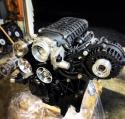
I would be a little worried that if the surface truly is that smooth maybe the lifter wont roll as it should and the coating will not stand up to that abuse the way the bare metal would... I could see it causing a problem faster than the tougher polished metal surface. No science to back that up... it would just be my concern.
Jun 9, 2017 | 07:17 PM
#354
Not being a douche here just discussing.....If the surface is so slick that the roller doesn't roll and slides over the surface then wouldn't it be slick enough that the sliding wouldn't cause any flat spots? Sliding is more friction than rolling so if it's too slick to roll (less friction) then wouldn't it be to slick to slide (more friction)? The needle bearings inside the roller will have more friction than the roller and cam lobe have now which in turn will still make the roller roll especially with the downward force applied by the pushrod. The coating bonds to the surface and I have been unable to remove it on test pieces short of sanding or blasting it off. Dry film coated bearings are the exact same as this stuff. They reduce friction even with a oil boundary layer present and give protection. Coated main, rod, and cam bearings are the exact same thing as this plus crank journals are polished mirror smooth. The coating retains oil more so than bare metal which is a good thing since bare metal doesn't want oil to stick to it. Cam lobes get burnished completely smooth and have a mirror like appearance after break in anyways just look at used cams and used roller lifters. Anything that reduces friction also reduces heat and makes more power two fold through cooler engine and less friction.
I'll send a small square test piece of coated metal to anyone that wants to pay for shipping. Without sanding or blasting the coating off but rather sliding one coated part against a uncoated part or two coated parts together the coating may burnish off and not be visible anymore the moly platelets are still there chemically bonded to the substrate doing their thing. I'm confident you'll change your minds if you had a piece in hand even though I'm obviously going to do it all anyways. (Not being a douche here just speaking)....Having a semi coarse surface in order to retain more oil is way way old tech. Smoother is better is every which way...pair that with a coating that retains oil and has less friction you have a winner. Euro cars coat their cams from the factory will Dry film coatings. I'm confident that the little bit of time spent on all these parts that are equally as important as the next will pay off. Maybe not in increased hp but at least in durability and longevity. Why blueprint the shortblock and not every other component? Companies may make good or excellent parts but they make it with the intent to make a dollar themselves and sell it at a cost that customers will pay for leaving each part with room for improvement...even though some improvements might be tiny and unnoticeable. I have much less time and effort into doing all this than one may think and I would be hard pressed to believe it was all for nothing. How many people just rinse the parts and slap them on? 99% I would think.
I'll send a small square test piece of coated metal to anyone that wants to pay for shipping. Without sanding or blasting the coating off but rather sliding one coated part against a uncoated part or two coated parts together the coating may burnish off and not be visible anymore the moly platelets are still there chemically bonded to the substrate doing their thing. I'm confident you'll change your minds if you had a piece in hand even though I'm obviously going to do it all anyways. (Not being a douche here just speaking)....Having a semi coarse surface in order to retain more oil is way way old tech. Smoother is better is every which way...pair that with a coating that retains oil and has less friction you have a winner. Euro cars coat their cams from the factory will Dry film coatings. I'm confident that the little bit of time spent on all these parts that are equally as important as the next will pay off. Maybe not in increased hp but at least in durability and longevity. Why blueprint the shortblock and not every other component? Companies may make good or excellent parts but they make it with the intent to make a dollar themselves and sell it at a cost that customers will pay for leaving each part with room for improvement...even though some improvements might be tiny and unnoticeable. I have much less time and effort into doing all this than one may think and I would be hard pressed to believe it was all for nothing. How many people just rinse the parts and slap them on? 99% I would think.
 Jun 10, 2017 | 12:17 PM
#356
Jun 10, 2017 | 01:15 PM
#357


Joined: Jan 2006
Posts: 16,282
Likes: 438
From: Huntsville, AL
The coefficient of friction while sliding is less than when rolling.
Think about your car, when you start sliding, you keep sliding. If it were more friction you would instantly regain traction.
Think about your car, when you start sliding, you keep sliding. If it were more friction you would instantly regain traction.
Jun 10, 2017 | 01:37 PM
#358
It takes more power to slide something than to roll something or else we'd all still use flat tapper lifters and cam sprockets without roller bearings etc etc
Think about it...rolling "resistance" vs sliding...can you more easily push a vehicle in neutral (rolling) or in park (sliding). The above analogy is flawed. It takes more power to break traction and slide (power brake , more gas etc) than it does to barely press the gas and go.
As for parts sliding or rolling on a oil boundary layer the same holds true still. That's why they make roller cam bearings , wheel bearings etc. The solid bearings in the crank and rods take a beating so hard that roller bearings fail or else they would use them. (They tried it before)
Last edited by Petraszewsky; Jun 10, 2017 at 01:51 PM.
Jun 10, 2017 | 01:59 PM
#359
Joined: Jan 2006
Posts: 16,282
Likes: 438
From: Huntsville, AL
Kind of, I was confusing coefficient of static friction (more akin to rolling) to kinetic friction (more akin to sliding). Static friction is always more than kinetic friction. Sorry, its been a while.
It takes more force to overcome that static friction (get it sliding) than it does to keep it sliding. Think about pushing something on the ground, as long as you can get it started then its easier to mantain movement. It doesnt get harder to push as soon as it starts moving.
Heres some numbers for you to play with http://www.engineersedge.com/coeffients_of_friction.htm
It takes more force to overcome that static friction (get it sliding) than it does to keep it sliding. Think about pushing something on the ground, as long as you can get it started then its easier to mantain movement. It doesnt get harder to push as soon as it starts moving.
Heres some numbers for you to play with http://www.engineersedge.com/coeffients_of_friction.htm
Last edited by Atomic; Jun 10, 2017 at 02:05 PM.
Jun 10, 2017 | 02:08 PM
#360
Would you rather slide a flat bottomed car across asphalt or roll it across? Once I get the flat bottomed car moving is it still easier to slide than the rolling one once it's moving?
The ice analogy is fluid friction (water) which is less than sliding and even rolling
The ice analogy is fluid friction (water) which is less than sliding and even rolling
Last edited by Petraszewsky; Jun 10, 2017 at 02:14 PM.