


Excessive turbo smoke!!! Need help please
 Feb 14, 2017 | 11:27 AM
#41



I was actually switching mine around before I got busy building a new shop last year. I will be going off the front of both valve covers with -10 to a large catch can. I feel that I was getting a lot of oil from the rear of the driver's side.
 Feb 15, 2017 | 02:21 PM
#43

Can I vent the VC's back into the TB with a check valve? I do not not have a 90* turbo elbow with nipple, just a plain cone filter...... I would like to find one of those heavy rubber elbows and install a nipple and vent pass. cover into the turbo and vent D/S into catch can


 Feb 15, 2017 | 03:34 PM
#45
I ran mine the way OEMs have done it and it worked up to the 850 hp level.
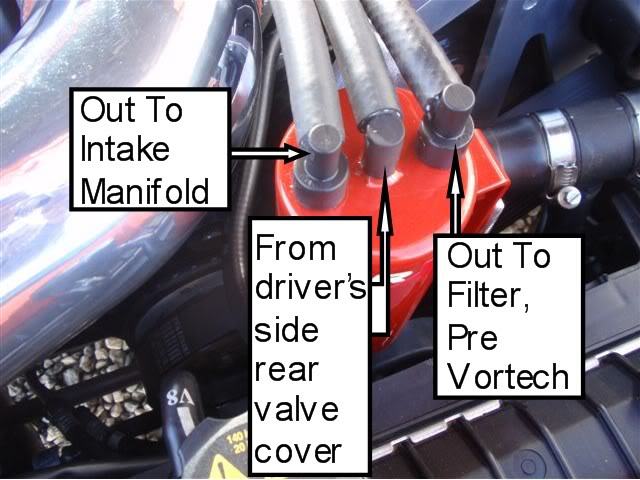
Hose from turbo inlet to passenger valve cover (supposedly pulls vacuum while under boost). You could have some kind of oil separator here, but I never saw any significant oil buildup on the compressor.
Catch can in between driver VC and intake manifold.
Once I went above that level, I straight vented the VCs. I do believe Quik was correct, ideally, crankcase gases should not be recirculated back into the intake, however, I do believe PCV is beneficial for a street motor.
Hose from turbo inlet to passenger valve cover (supposedly pulls vacuum while under boost). You could have some kind of oil separator here, but I never saw any significant oil buildup on the compressor.
Catch can in between driver VC and intake manifold.
Once I went above that level, I straight vented the VCs. I do believe Quik was correct, ideally, crankcase gases should not be recirculated back into the intake, however, I do believe PCV is beneficial for a street motor.

 Feb 16, 2017 | 11:18 AM
#47

Joined: Jan 2006
Posts: 16,282
Likes: 438
From: Huntsville, AL
I'll answer your PM here so it adds to the convo, but there really isnt a "best" way to do it, it depends on how you drive, how much you want to spend, and how fancy you want to be.
The cheapest and easiest is to vent the valve covers to atmosphere, this includes using a vented catch can with no reciculation:
Pros: Cheap (~$50), easy, effective, high breathing capacity
Cons: May have oil smell, no crankcase vacuum
Catch can that recirculates to a vaccum source (turbo inlet or pre blower). You can use multiple cans for more breathing capacity:
Pros: Affordable (~$100), crankcase vacuum
Cons: limited breathing capacity, potential oil ingestion, potential crankcase pressure buildup
Fancy catch can with check valves and breather vents (mighty mouse, rx, etc.):
Pros: Looks cool, crankcase vaccum, more breathing capacity
Cons: More expensive (~$200+), lot of plumbing, potential check valve failure, potentially not enough breathing capacity
Vacuum pump to actively pull vacuum on the crankcase at all times:
Pros: Best solution, more power, best venting
Cons: Very expensive (~$1000), pump placement and belt drive, pump maintenance
The cheapest and easiest is to vent the valve covers to atmosphere, this includes using a vented catch can with no reciculation:
Pros: Cheap (~$50), easy, effective, high breathing capacity
Cons: May have oil smell, no crankcase vacuum
Catch can that recirculates to a vaccum source (turbo inlet or pre blower). You can use multiple cans for more breathing capacity:
Pros: Affordable (~$100), crankcase vacuum
Cons: limited breathing capacity, potential oil ingestion, potential crankcase pressure buildup
Fancy catch can with check valves and breather vents (mighty mouse, rx, etc.):
Pros: Looks cool, crankcase vaccum, more breathing capacity
Cons: More expensive (~$200+), lot of plumbing, potential check valve failure, potentially not enough breathing capacity
Vacuum pump to actively pull vacuum on the crankcase at all times:
Pros: Best solution, more power, best venting
Cons: Very expensive (~$1000), pump placement and belt drive, pump maintenance