


Vortec350ss 2005 Sierra Denali - Forged 370 and cog driven TVS2300
 Dec 11, 2016 | 10:39 AM
#1031


Two reasons:
#1, yes they do.
#2, you don't hear about them because the vast majority bolt them on at whatever boost/pulley they come with and leave them alone for 100K miles.
The Procharger family lends itself to modification a little better IMO. This is why you hear more about difficulties with belts etc than the others, for reasons explained above.
Dec 11, 2016 | 11:01 AM
#1032


Joined: Jan 2006
Posts: 16,282
Likes: 438
From: Huntsville, AL
That's not the purpose of the tensioner. The tensioners are always on the slack side of the belt and they are there primarily to keep tension in the belt as the belt stretches. A narrower belt will stretch more. If you can't hold tension on the belt on the slack side it starts flopping around and either slips or gets thrown, but as long as its not slipping or loosing tension due to inadequate range to take up the slack a heavier tensioner won't do any good. Perfect example, if you can dead hook on a 10" radial, going to a 14" slick isn't gaining you anything.
Load per rib is interesting I guess but isn't really useful. Friction is defined by the surface area of contact times the force acting perpendicular to the surface. Adding ribs is far more beneficial than trying to use massive tensioners.
Load per rib is interesting I guess but isn't really useful. Friction is defined by the surface area of contact times the force acting perpendicular to the surface. Adding ribs is far more beneficial than trying to use massive tensioners.
Dec 11, 2016 | 11:31 AM
#1033
 Dec 11, 2016 | 11:38 AM
#1034
Thread Starter
Moderator
iTrader: (20)
Joined: Feb 2006
Posts: 7,271
Likes: 62
From: South Shore, MA
So Richard with that in mind we could fairly easily figure out what would work best given that there are far more large diameter options for an 8 rib. You could have a larger blower pulley with better belt wrap.
I'm sure the 12 rib is still better. But its not 50% better as it initially sounds. The other fear is moving the tension that much further away from the crank. That has to take its toll...
This is all for what is my second choice as of right. Ow. But it's not out of the question by any stretch.
I'm sure the 12 rib is still better. But its not 50% better as it initially sounds. The other fear is moving the tension that much further away from the crank. That has to take its toll...
This is all for what is my second choice as of right. Ow. But it's not out of the question by any stretch.
 Dec 11, 2016 | 01:05 PM
#1036
Joined: Jan 2006
Posts: 16,282
Likes: 438
From: Huntsville, AL
Belt load is already in my blower pulley spreadsheet. Steady state power required is pretty easy just need to know the blower efficiency, airflow, and output pressure. Dynamic load is a lot harder and you need to know the above things as well as the internal rotating mass of the rotors as well as the acceleration rate.
Here is a nice little page on it if anyone else wants to do it http://adaptivemap.ma.psu.edu/websit...tfriction.html. In our case the "resting tension" would be the tensioner...tension. I measured this on a normal blower tensioner and HD tensioner a while back, its somewhere around here.
Here is a nice little page on it if anyone else wants to do it http://adaptivemap.ma.psu.edu/websit...tfriction.html. In our case the "resting tension" would be the tensioner...tension. I measured this on a normal blower tensioner and HD tensioner a while back, its somewhere around here.
Last edited by Atomic; Dec 11, 2016 at 01:12 PM.

 Dec 12, 2016 | 12:18 AM
#1039

So Richard with that in mind we could fairly easily figure out what would work best given that there are far more large diameter options for an 8 rib. You could have a larger blower pulley with better belt wrap.
I'm sure the 12 rib is still better. But its not 50% better as it initially sounds. The other fear is moving the tension that much further away from the crank. That has to take its toll...
This is all for what is my second choice as of right. Ow. But it's not out of the question by any stretch.
I'm sure the 12 rib is still better. But its not 50% better as it initially sounds. The other fear is moving the tension that much further away from the crank. That has to take its toll...
This is all for what is my second choice as of right. Ow. But it's not out of the question by any stretch.
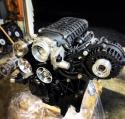
Front main bearings looked good upon tear down as well.
