


Another lost torque / header thread
 Jul 20, 2015 | 02:25 PM
#23

Thread Starter
Staging Lane
Joined: May 2015
Posts: 76
Likes: 0
From: Pearl River, Louisiana, United States

Hey There, So some more questions. The truck was running really decent the first week and some when I first installed the new computer before I installed the headers. After I did the install its really doggy from a dig. After some research here I am being told "*** Quote:
Originally Posted by Fast355
Sounds like your GMS/CYL reading has increased and retarded your timing or you are hitting the torque limit value and the PCM is retarding the timing. My Express van did both when I put headers on it. Fixed the tune and had more torque than ever.
Stock 5.3 probably runs about .56 to .60 gms/cyl. With headers and exhaust maybe .64 to .72 gms/cyl. Substantially retards the timing at all RPMs.
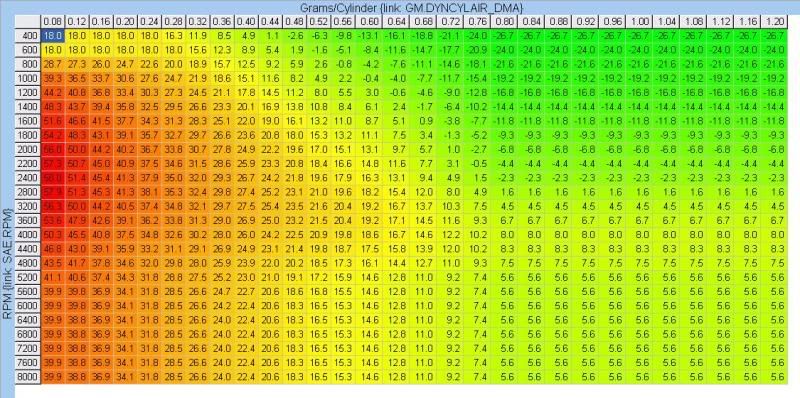
An increase in actual cylinder air mass would increase torque, despite there being less timing. The timing decreases because the knock limit is reached at a lower ignition timing value at higher g/cyl. For higher air mass, timing must always decrease.
The scavenging effect from long tube headers is efficient enough not only to deplete the cylinder of exhaust gases, but also to draw fresh air and fuel out of the cylinder when the intake and exhaust valves are both open. This is air mass that would ordinarily be contributing to torque production, but is instead wasted as it is expelled as exhaust. There is no parameter to manage this effect directly in the tune, so it must be implicitly addressed in the VE table that generates the cylinder air mass estimate and in the timing table. Firstly, since the header changes the effective volumetric efficiency of the cylinder in question, the VE value in the tune must be adjusted to correct the injected fuel mass while in SD mode. This will maintain the target fuel mixture and therefore keep the efficiency model accurate. The timing table is where you make changes implicitly for rpm and load-dependent efficiency effects that cannot be modeled in the VE table. Since actual g/cyl is lower than PCM predicted g/cyl due to the scavenging effect, you may actually increase timing at higher cylinder air mass. In fact you should because otherwise torque will be left on the table. ***"
My headers are PaceSetter Long Tube Headers 70-2265 with a 3 inch y pipe and a 3 inch exhaust pipe
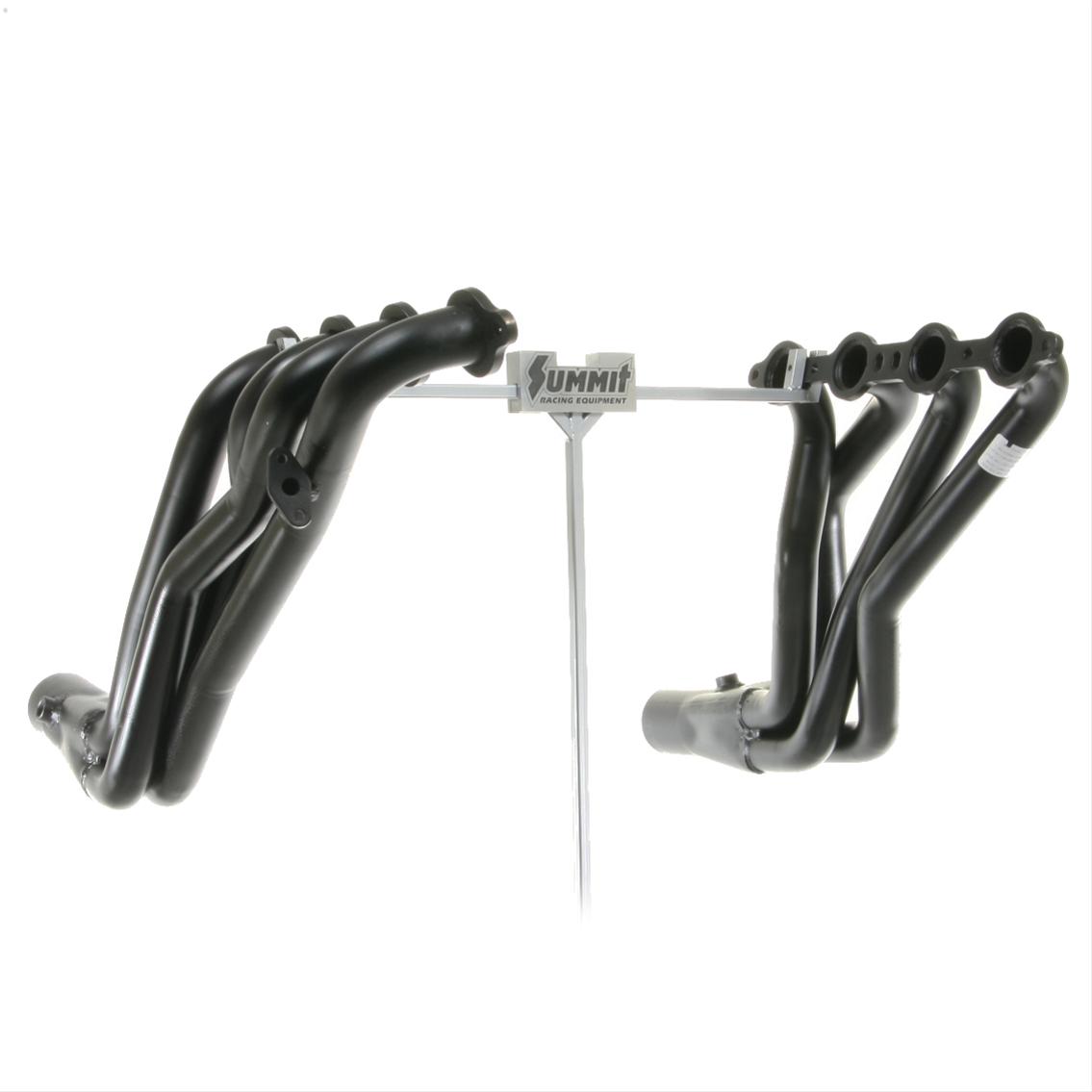
PaceSetter Long Tube Headers 70-2265Find PaceSetter Long Tube Headers 70-2265 and get Free Shipping on Orders Over $99 at Summit Racing! PaceSetter Long Tube Headers are made in the U.S. PaceS...
View on www.summitracing.com
I am getting a p1154 every week or so since the tune. Went ahead and changed o2s, checked for leaks and its still there. Did some research and most likely its because the sensor is further down in the exhaust. Can y'all tune for that? Also my rears o2s are deleted, not sure if y'all can tune for that as well.
Also Id like to move up to the 93 tune. how can we go about retuning without me being truckless for 2 weeks or so. Its my DD and I need it for work, I use it to deliver. I kept the original pcm just in case anything were to happen. Can I send that one in to get the tune?
Thank you kindly,
Blaise Pinero
Originally Posted by Fast355
Sounds like your GMS/CYL reading has increased and retarded your timing or you are hitting the torque limit value and the PCM is retarding the timing. My Express van did both when I put headers on it. Fixed the tune and had more torque than ever.
Stock 5.3 probably runs about .56 to .60 gms/cyl. With headers and exhaust maybe .64 to .72 gms/cyl. Substantially retards the timing at all RPMs.
An increase in actual cylinder air mass would increase torque, despite there being less timing. The timing decreases because the knock limit is reached at a lower ignition timing value at higher g/cyl. For higher air mass, timing must always decrease.
The scavenging effect from long tube headers is efficient enough not only to deplete the cylinder of exhaust gases, but also to draw fresh air and fuel out of the cylinder when the intake and exhaust valves are both open. This is air mass that would ordinarily be contributing to torque production, but is instead wasted as it is expelled as exhaust. There is no parameter to manage this effect directly in the tune, so it must be implicitly addressed in the VE table that generates the cylinder air mass estimate and in the timing table. Firstly, since the header changes the effective volumetric efficiency of the cylinder in question, the VE value in the tune must be adjusted to correct the injected fuel mass while in SD mode. This will maintain the target fuel mixture and therefore keep the efficiency model accurate. The timing table is where you make changes implicitly for rpm and load-dependent efficiency effects that cannot be modeled in the VE table. Since actual g/cyl is lower than PCM predicted g/cyl due to the scavenging effect, you may actually increase timing at higher cylinder air mass. In fact you should because otherwise torque will be left on the table. ***"
My headers are PaceSetter Long Tube Headers 70-2265 with a 3 inch y pipe and a 3 inch exhaust pipe
PaceSetter Long Tube Headers 70-2265Find PaceSetter Long Tube Headers 70-2265 and get Free Shipping on Orders Over $99 at Summit Racing! PaceSetter Long Tube Headers are made in the U.S. PaceS...
View on www.summitracing.com
Preview by Yahoo
I am getting a p1154 every week or so since the tune. Went ahead and changed o2s, checked for leaks and its still there. Did some research and most likely its because the sensor is further down in the exhaust. Can y'all tune for that? Also my rears o2s are deleted, not sure if y'all can tune for that as well.
Also Id like to move up to the 93 tune. how can we go about retuning without me being truckless for 2 weeks or so. Its my DD and I need it for work, I use it to deliver. I kept the original pcm just in case anything were to happen. Can I send that one in to get the tune?
Thank you kindly,
Blaise Pinero
Jul 20, 2015 | 02:54 PM
#24
Thread Starter
Staging Lane
Joined: May 2015
Posts: 76
Likes: 0
From: Pearl River, Louisiana, United States
This is an excerpt from his email "...
Your engine is doggy from a dig because of the LACK of scavenging at low RPM which is caused by too large of pipes for that operating range. Smaller diameter pipes make more low end but become a restriction at high RPM whereas larger pipes reduce exhaust velocity at low RPM but make up for it by allowing for greater horsepower due to lack of restriction at high RPM.
I did a dyno test of 1-5/8" vs 1-7/8" (otherwise identical) headers on my 6.2L truck. Even with that much larger engine than you are running (which has greater exhaust flow requirements), the 1-5/8" header made more power until over 4500rpm than the 1-7/8" did. Even at 6000rpm, the 1-7/8" only made 3% more power than the 1-5/8".
P1154 can be taken care of, but is a fairly rare code to pop up. 1133 and 1153 are much more common. ..."
Your engine is doggy from a dig because of the LACK of scavenging at low RPM which is caused by too large of pipes for that operating range. Smaller diameter pipes make more low end but become a restriction at high RPM whereas larger pipes reduce exhaust velocity at low RPM but make up for it by allowing for greater horsepower due to lack of restriction at high RPM.
I did a dyno test of 1-5/8" vs 1-7/8" (otherwise identical) headers on my 6.2L truck. Even with that much larger engine than you are running (which has greater exhaust flow requirements), the 1-5/8" header made more power until over 4500rpm than the 1-7/8" did. Even at 6000rpm, the 1-7/8" only made 3% more power than the 1-5/8".
P1154 can be taken care of, but is a fairly rare code to pop up. 1133 and 1153 are much more common. ..."
Jul 20, 2015 | 03:48 PM
#25

TECH Enthusiast


Joined: Oct 2006
Posts: 642
Likes: 21
From: Euless, TX
This is an excerpt from his email "...
Your engine is doggy from a dig because of the LACK of scavenging at low RPM which is caused by too large of pipes for that operating range. Smaller diameter pipes make more low end but become a restriction at high RPM whereas larger pipes reduce exhaust velocity at low RPM but make up for it by allowing for greater horsepower due to lack of restriction at high RPM.
I did a dyno test of 1-5/8" vs 1-7/8" (otherwise identical) headers on my 6.2L truck. Even with that much larger engine than you are running (which has greater exhaust flow requirements), the 1-5/8" header made more power until over 4500rpm than the 1-7/8" did. Even at 6000rpm, the 1-7/8" only made 3% more power than the 1-5/8".
P1154 can be taken care of, but is a fairly rare code to pop up. 1133 and 1153 are much more common. ..."
Your engine is doggy from a dig because of the LACK of scavenging at low RPM which is caused by too large of pipes for that operating range. Smaller diameter pipes make more low end but become a restriction at high RPM whereas larger pipes reduce exhaust velocity at low RPM but make up for it by allowing for greater horsepower due to lack of restriction at high RPM.
I did a dyno test of 1-5/8" vs 1-7/8" (otherwise identical) headers on my 6.2L truck. Even with that much larger engine than you are running (which has greater exhaust flow requirements), the 1-5/8" header made more power until over 4500rpm than the 1-7/8" did. Even at 6000rpm, the 1-7/8" only made 3% more power than the 1-5/8".
P1154 can be taken care of, but is a fairly rare code to pop up. 1133 and 1153 are much more common. ..."
Jul 20, 2015 | 05:11 PM
#26

Formerly ScreamingL
Joined: Oct 2003
Posts: 3,456
Likes: 5
From: From the 412
This is an excerpt from his email "...
Your engine is doggy from a dig because of the LACK of scavenging at low RPM which is caused by too large of pipes for that operating range. Smaller diameter pipes make more low end but become a restriction at high RPM whereas larger pipes reduce exhaust velocity at low RPM but make up for it by allowing for greater horsepower due to lack of restriction at high RPM.
I did a dyno test of 1-5/8" vs 1-7/8" (otherwise identical) headers on my 6.2L truck. Even with that much larger engine than you are running (which has greater exhaust flow requirements), the 1-5/8" header made more power until over 4500rpm than the 1-7/8" did. Even at 6000rpm, the 1-7/8" only made 3% more power than the 1-5/8".
P1154 can be taken care of, but is a fairly rare code to pop up. 1133 and 1153 are much more common. ..."
Your engine is doggy from a dig because of the LACK of scavenging at low RPM which is caused by too large of pipes for that operating range. Smaller diameter pipes make more low end but become a restriction at high RPM whereas larger pipes reduce exhaust velocity at low RPM but make up for it by allowing for greater horsepower due to lack of restriction at high RPM.
I did a dyno test of 1-5/8" vs 1-7/8" (otherwise identical) headers on my 6.2L truck. Even with that much larger engine than you are running (which has greater exhaust flow requirements), the 1-5/8" header made more power until over 4500rpm than the 1-7/8" did. Even at 6000rpm, the 1-7/8" only made 3% more power than the 1-5/8".
P1154 can be taken care of, but is a fairly rare code to pop up. 1133 and 1153 are much more common. ..."
Jul 20, 2015 | 08:22 PM
#29
TECH Enthusiast
Joined: Oct 2006
Posts: 642
Likes: 21
From: Euless, TX
Not at all!! Simple physics at work. Hell the exhaust valve is not even 1.6" in diameter much less 1.75.
Good scavenging has everything to do with good velocity and heat retention. The hotter the gases stay (smaller, thicker, coated primaries all help) the faster they flow and the better the chamber scavenges.
My old "gutless" Vortec 350 with properly sized Tri-Y headers, running 3" headpipes had no problem pushing the Express van loaded up with 6 people our camping and tubing gear at over 7,000 lbs down the fast lane in OD at 85-95 mph with the flow of traffic yesterday and never dropped out of lockup much less downshifted. Just tip into the throttle and it would easily accelerate even uphill. Pulled down 16.5 mpg despite turning 2,400-2,800 rpm practically the whole trip. A 4.8 or 5.3 running the same RPM does not even need as much header primary as my 350. Doug Thorley definately knows what they are doing when it comes to headers and their intended application and know how to build torque in a useable rpm range.
Good scavenging has everything to do with good velocity and heat retention. The hotter the gases stay (smaller, thicker, coated primaries all help) the faster they flow and the better the chamber scavenges.
My old "gutless" Vortec 350 with properly sized Tri-Y headers, running 3" headpipes had no problem pushing the Express van loaded up with 6 people our camping and tubing gear at over 7,000 lbs down the fast lane in OD at 85-95 mph with the flow of traffic yesterday and never dropped out of lockup much less downshifted. Just tip into the throttle and it would easily accelerate even uphill. Pulled down 16.5 mpg despite turning 2,400-2,800 rpm practically the whole trip. A 4.8 or 5.3 running the same RPM does not even need as much header primary as my 350. Doug Thorley definately knows what they are doing when it comes to headers and their intended application and know how to build torque in a useable rpm range.
Last edited by Fast355; Jul 20, 2015 at 08:42 PM.
Jul 20, 2015 | 09:28 PM
#30
TECH Enthusiast
Joined: Oct 2006
Posts: 642
Likes: 21
From: Euless, TX
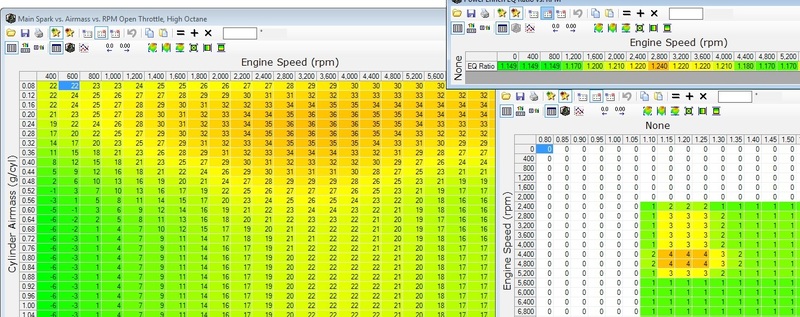
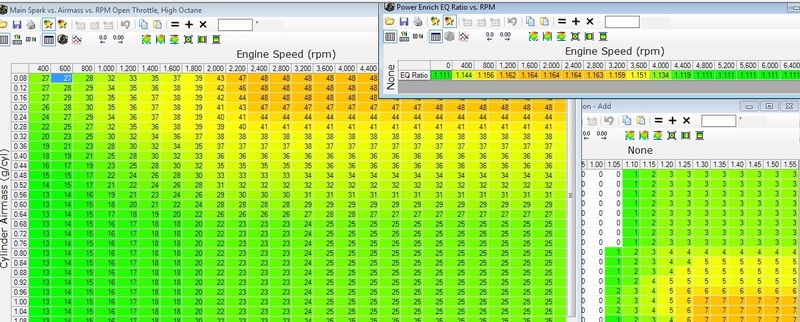
Further improving what I was saying about the GMS/CYL timing map I was talking about. GM is ultra conservative in the areas that the vehicle is heavily loaded in or above the normal range of operation. With my marine intake, Etec 170 heads, 215/220 @ .050 cam, Thorley Tri-Ys and free flowing exhaust system I went from 0.64 near peak torque and 0.58 at the 5,000 rpm shift point up to about about 1.02 near peak torque and 0.96 at fuel shut-off at 6,200 rpm. Even down at 1,500 rpm I am reading in the 0.84 range. Its all about the components working togather and having a good tune to match.
Stock GM L31 Timing Map
My Timing Map
Difference
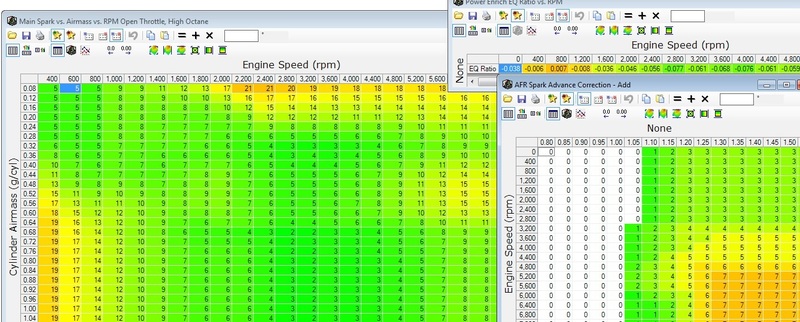
With my lower than stock dynamic compression ratio, aluminum heads, and cooler running from the 454 radiator my setup LOVES timing advance. Air mass, cylinder pressure and scavenging are much better than the stock setup and with the ability to run full timing on 87 octane its pretty darn efficient at making power out of cheap fuel.
Stock GM L31 Timing Map
My Timing Map
Difference
With my lower than stock dynamic compression ratio, aluminum heads, and cooler running from the 454 radiator my setup LOVES timing advance. Air mass, cylinder pressure and scavenging are much better than the stock setup and with the ability to run full timing on 87 octane its pretty darn efficient at making power out of cheap fuel.

