


Another lost torque / header thread

 Jun 30, 2015 | 05:19 PM
#13


I kind of know what you mean. When I did my headers and exhaust it almost felt not quite as snappy off the bottom. But at the same time, I can also light the tires up a lot easier now than ever before.
Jun 30, 2015 | 09:33 PM
#14

TECH Enthusiast


Joined: Oct 2006
Posts: 642
Likes: 21
From: Euless, TX
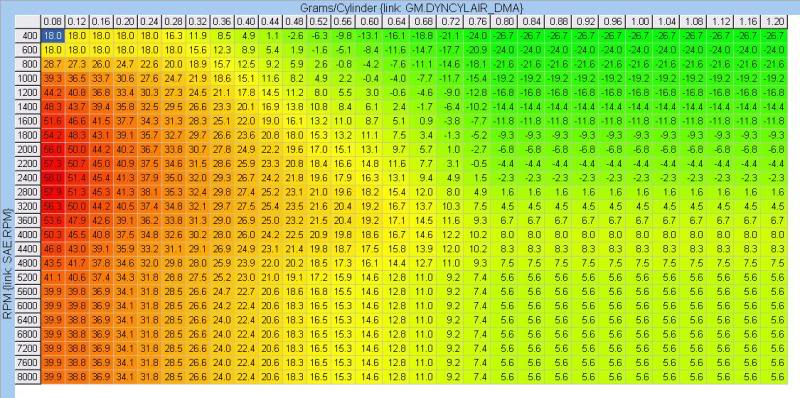
Sounds like your GMS/CYL reading has increased and retarded your timing or you are hitting the torque limit value and the PCM is retarding the timing. My Express van did both when I put headers on it. Fixed the tune and had more torque than ever.
Stock 5.3 probably runs about .56 to .60 gms/cyl. With headers and exhaust mayve .64 to .72 gms/cyl. Substantially retards the timing at all RPMs.
Stock 5.3 probably runs about .56 to .60 gms/cyl. With headers and exhaust mayve .64 to .72 gms/cyl. Substantially retards the timing at all RPMs.

Last edited by Fast355; Jun 30, 2015 at 09:40 PM.
Jun 30, 2015 | 10:41 PM
#15

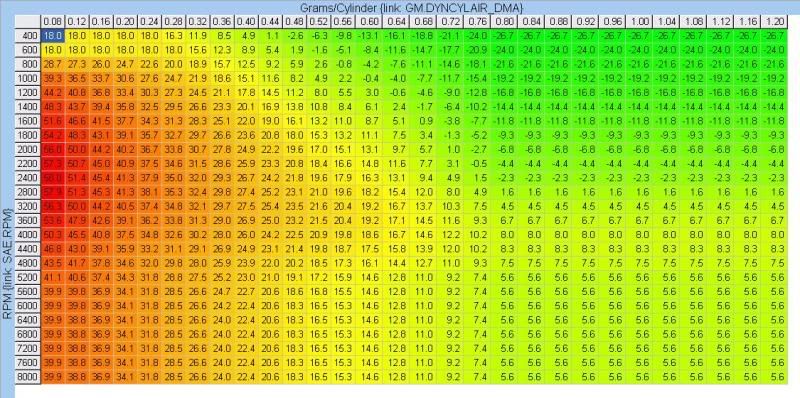
Sounds like your GMS/CYL reading has increased and retarded your timing or you are hitting the torque limit value and the PCM is retarding the timing. My Express van did both when I put headers on it. Fixed the tune and had more torque than ever.
Stock 5.3 probably runs about .56 to .60 gms/cyl. With headers and exhaust mayve .64 to .72 gms/cyl. Substantially retards the timing at all RPMs.
Stock 5.3 probably runs about .56 to .60 gms/cyl. With headers and exhaust mayve .64 to .72 gms/cyl. Substantially retards the timing at all RPMs.
The scavenging effect from long tube headers is efficient enough not only to deplete the cylinder of exhaust gases, but also to draw fresh air and fuel out of the cylinder when the intake and exhaust valves are both open. This is air mass that would ordinarily be contributing to torque production, but is instead wasted as it is expelled as exhaust. There is no parameter to manage this effect directly in the tune, so it must be implicitly addressed in the VE table that generates the cylinder air mass estimate and in the timing table. Firstly, since the header changes the effective volumetric efficiency of the cylinder in question, the VE value in the tune must be adjusted to correct the injected fuel mass while in SD mode. This will maintain the target fuel mixture and therefore keep the efficiency model accurate. The timing table is where you make changes implicitly for rpm and load-dependent efficiency effects that cannot be modeled in the VE table. Since actual g/cyl is lower than PCM predicted g/cyl due to the scavenging effect, you may actually increase timing at higher cylinder air mass. In fact you should because otherwise torque will be left on the table.
 Jul 1, 2015 | 01:50 AM
#17

Thread Starter
Staging Lane
Joined: May 2015
Posts: 76
Likes: 0
From: Pearl River, Louisiana, United States
Fast355 and smokeshow, Guys.... I don't even.... What?
Ok, Fast. I get what your saying more or less. Grams of what exactly per cylinder?
Smoke. I am fully with you up until "so it must be implicitly addressed...ect"
I am still new to this whole tuning deal, Dumb it down a bit for me guys.
Ok, Fast. I get what your saying more or less. Grams of what exactly per cylinder?
Smoke. I am fully with you up until "so it must be implicitly addressed...ect"
I am still new to this whole tuning deal, Dumb it down a bit for me guys.
Jul 1, 2015 | 02:27 AM
#19
Fast355 and smokeshow, Guys.... I don't even.... What?
Ok, Fast. I get what your saying more or less. Grams of what exactly per cylinder?
Smoke. I am fully with you up until "so it must be implicitly addressed...ect"
I am still new to this whole tuning deal, Dumb it down a bit for me guys.
Ok, Fast. I get what your saying more or less. Grams of what exactly per cylinder?
Smoke. I am fully with you up until "so it must be implicitly addressed...ect"
I am still new to this whole tuning deal, Dumb it down a bit for me guys.
You adjust the efficiency number in VE to account for the extra air that moves through the cylinder, regardless whether it stays in the cylinder or ends up flowing out of the cylinder during valve overlap. Fuel must be in proportion to air. But that efficiency value is false if you think about it...it's an overestimate because of the air/fuel mix that left without being burned. But the tune can't account for that; there is no way to tell it how much fuel and air leaves the cylinder without being burned. And since there is less air in the cylinder than the PCM thinks, you can and need to increase the timing to account for that. These effects are minimal with stock camshafts, but it becomes very important when you have a camshaft suited to high-rpm power.

