


Went out tonight to test the nitrous.......


 Nov 22, 2008 | 07:46 PM
#23

Thread Starter
13 Second Truck Club
iTrader: (13)
Joined: Mar 2008
Posts: 2,663
Likes: 0
From: Arlington (DFW), Texas


BTW, I am not trying to be difficult, I am trying to understand this and learn, lol.
Nov 22, 2008 | 08:02 PM
#24
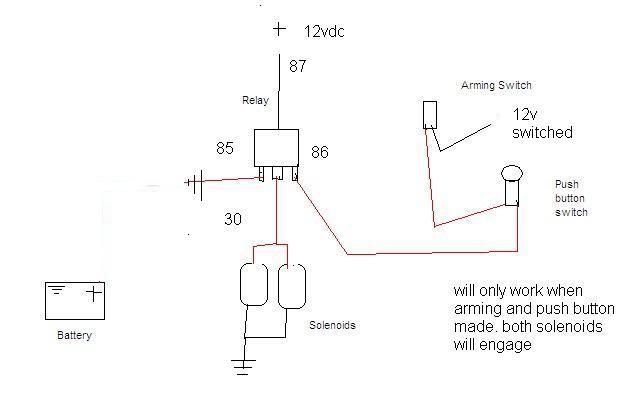
Pin 85 and 86 polarity doesn't matter. Those are the pins that feed the relay coil. As long as you have + on one and - on the other your are good to go. Same goes for 87 and 30 except this is the switch/contact side.
Last edited by KySilverado; Nov 22, 2008 at 08:08 PM.
Nov 22, 2008 | 08:05 PM
#25

Okay. A relay allows a low amp circuit to control a high am circuit. That is the definition.
Pin 30 is the power 12V that is going to make the circuit work.
Pin 87a in this case is nothing.
Pin 87 is going to be what turns the solenoid on.
Pin 85 is going to have a 12V going to it.
Pin 86 is going to be the ground (switch controlled) that will energize the coil inside the relay and allow the pole in the relay to switch from 87a to 87.
To answer your question about 85 and 86 they can be switched, there is just a coil between them that is energized when power is allowed to flow through them.
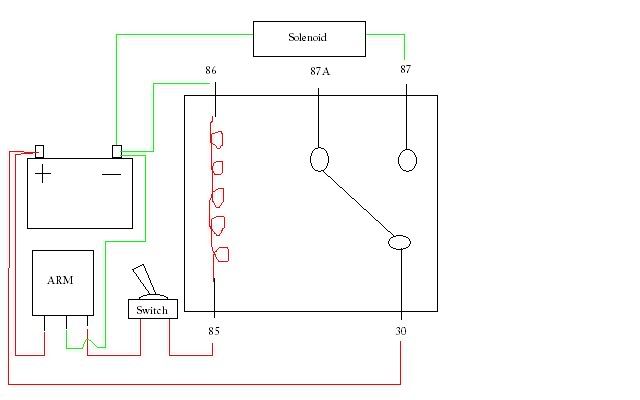
Everyone drew a picture, here is mine.
(i hope this helped in your learning )
)
Dustin
Pin 30 is the power 12V that is going to make the circuit work.
Pin 87a in this case is nothing.
Pin 87 is going to be what turns the solenoid on.
Pin 85 is going to have a 12V going to it.
Pin 86 is going to be the ground (switch controlled) that will energize the coil inside the relay and allow the pole in the relay to switch from 87a to 87.
To answer your question about 85 and 86 they can be switched, there is just a coil between them that is energized when power is allowed to flow through them.
Everyone drew a picture, here is mine.
(i hope this helped in your learning
)Dustin
Last edited by 2005 Silverado; Nov 22, 2008 at 08:33 PM.
Nov 22, 2008 | 08:24 PM
#26
Thread Starter
13 Second Truck Club
iTrader: (13)
Joined: Mar 2008
Posts: 2,663
Likes: 0
From: Arlington (DFW), Texas
Okay. A relay allows a low amp circuit to control a high am circuit. That is the definition.
Pin 30 is the power 12V that is going to make the circuit work.
Pin 87a in this case is nothing.
Pin 87 is going to be what turns the solenoid on.
Pin 85 is going to have a 12V going to it.
Pin 86 is going to be the ground (switch controlled) that will energize the coil inside the relay and allow the pole in the relay to switch from 87a to 87.
To answer your question about 85 and 86 they can be switched, there is just a coil between them that is energized when power is allowed to flow through them.
(i hope this helped in your learning )
Dustin
Pin 30 is the power 12V that is going to make the circuit work.
Pin 87a in this case is nothing.
Pin 87 is going to be what turns the solenoid on.
Pin 85 is going to have a 12V going to it.
Pin 86 is going to be the ground (switch controlled) that will energize the coil inside the relay and allow the pole in the relay to switch from 87a to 87.
To answer your question about 85 and 86 they can be switched, there is just a coil between them that is energized when power is allowed to flow through them.
(i hope this helped in your learning
)Dustin
 Nov 22, 2008 | 08:48 PM
#29
yeah, i would think so but i don't recommend it. The Relay way allows you to, like i said before, Control a high amp circuit (solenoids) with the low amp circuit (very little power to light up a activation switch light).
Dustin
Dustin
Nov 22, 2008 | 09:52 PM
#30
Solenoids pull way to many amps to not use a relay. Unless you want to run wire the size of your middle finger along with an industrial size arming switch and pushbutton.
Last edited by KySilverado; Nov 22, 2008 at 09:58 PM.