


lsa
 Mar 1, 2009 | 12:46 AM
#1
Thread Starter
TECH Resident
Joined: Jul 2008
Posts: 865
Likes: 0
From: bakersfield, ca
 lsa
lsa
the whole lsa thing is not making sense to me, every one on the site here seems to be in consensus that a lower numerical lsa ~112 will bring down the power band and a higher numerical lsa ~118 would raise the power band. The deal is that everything i have seen says the opposite, that's why bracket cars that stay at 6k rpm for the entire race run a 106 lsa because the lower lsa moves up the peak torque in the power band, you wouldn't find any of them running a 118 that's for sure, why? if all the cam talk is true on this site they would be, but im just not seeing it. Not only that but isn't it pretty obvious that a rough idling cam that has to have the idle raised just to keep running basically another example of a low lsa cam being out of its power band? where as those smooth idling high lsa cams making torque right off idle? Take the comp cams truck cams for example they are all ground on a 115 lsa, why? did anyone notice that the biggest difference between the xr259 and the xfi260 is the xr259 is ground on a 112 lsa vs. the xfi260 being ground on a 115 and yet the xr259 runs out 800rpm higher than the xfi260. So my question is why put a tr224 ground on a 112 in a truck and then having to put in a 3500 rpm stall to make it work? and then all it does is spin the tires. has anyone ever looked at the tr blower cam and the CheaTR cam and noticed that its on a 117 lsa and it makes power from idle-6800 rpm? and it idles smoothly, and you wouldnt need a higher rpm stall to get the truck moving. I understand putting a cam in a heavy *** truck needs to be able to produce low end torqe to get the truck moving but it seems like you guys went the other way with it. was it just for the choppy idle? 
someone do some serious explaining for me. please.
someone do some serious explaining for me. please.
Last edited by 006rcsb; Mar 1, 2009 at 12:51 AM.
Mar 1, 2009 | 01:11 AM
#2


very much simplified, two cams with the same duration. the cam with a narrower lsa, or lower number, will make more power over a narrower range. the wider lsa cam will peak at about the same rpm, with less power, but more power above and below the peak. wider lsa gives a more ''pulls forever'' feeling, narrow pulls much harder at a certain rpm, the way i understand it.
Mar 1, 2009 | 01:23 AM
#3
TECH Addict
Joined: Dec 2007
Posts: 2,862
Likes: 0
From: Mesa, AZ
very much simplified, two cams with the same duration. the cam with a narrower lsa, or lower number, will make more power over a narrower range. the wider lsa cam will peak at about the same rpm, with less power, but more power above and below the peak. wider lsa gives a more ''pulls forever'' feeling, narrow pulls much harder at a certain rpm, the way i understand it.
Most guys that want a truck that is fast at the track will go for the lower lsa because during a 1/4 mile pass they spend most of their time between 5000-7000rpms and that is were the peaky cams make power
Mar 1, 2009 | 03:56 AM
#4

Found this on a Ricer forum of all places. Only pace that had a graph with the description. Very well laid out page.
Overlap can be increased in 2 ways independently:
- Increasing the Duration of the Cam (without changing the LSA)
- Reducing or Tightening the LSA (without changing the Duration)
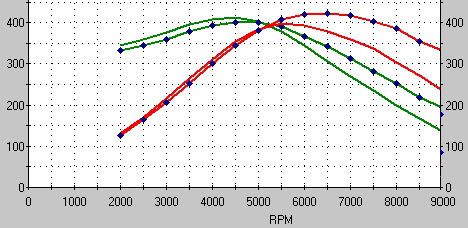
Affects of Changing LSA: Compare the cam with a bigger 116 degrees lobe separation (lines with no dots) with one having a 106-degree separation (with dots). The smaller LSA cam produces more peak horsepower but with a loss of low-end torque. Smaller or tighter LSA is better for a drag engine than a street machine, due to an increase in valve overlap.
Overlap can be increased in 2 ways independently:
- Increasing the Duration of the Cam (without changing the LSA)
- Reducing or Tightening the LSA (without changing the Duration)
Affects of Changing LSA: Compare the cam with a bigger 116 degrees lobe separation (lines with no dots) with one having a 106-degree separation (with dots). The smaller LSA cam produces more peak horsepower but with a loss of low-end torque. Smaller or tighter LSA is better for a drag engine than a street machine, due to an increase in valve overlap.
Last edited by viciousknid; Mar 1, 2009 at 03:24 PM.
Mar 1, 2009 | 11:46 AM
#5
Thread Starter
TECH Resident
Joined: Jul 2008
Posts: 865
Likes: 0
From: bakersfield, ca
what vicious posted proved my point perfectly,
for the most of the recommendations for cams around here are given for around a 220~ duration with a 112 lsa, which had me looking for the same thing, but my truck will spend alot more time on the street than at the track. most of the guys here are just looking for a nice dd cam, a higher lsa would be more suited for most of them.
Not everyone here is looking for a drag truck. Maybe its just me but i have never been one for "peak numbers". thanks for the clarification.
for the most of the recommendations for cams around here are given for around a 220~ duration with a 112 lsa, which had me looking for the same thing, but my truck will spend alot more time on the street than at the track. most of the guys here are just looking for a nice dd cam, a higher lsa would be more suited for most of them.
Not everyone here is looking for a drag truck. Maybe its just me but i have never been one for "peak numbers". thanks for the clarification.
Last edited by 006rcsb; Mar 1, 2009 at 12:04 PM.
Mar 1, 2009 | 12:43 PM
#6

Joined: Apr 2004
Posts: 16,820
Likes: 2
From: In a van DOWN BY THE RIVER
This is correct.. also you see the guys that are running tight lsa cams with big converters. This is due to the fact of the power being moved higher in the power band from the lsa and duration numbers.. Also you have to love the sound of the chop a tight lsa cam sounds like.. It is all what you want out of it..
Mar 1, 2009 | 01:16 PM
#7



Trending Topics
Mar 1, 2009 | 01:25 PM
#8
LSA is not what determines peak power rpm, duration is. I remember those old torquer truck cams from the '70s, with something like 4500 peak, and a really lopey idle from the narrow LSA.
Mar 1, 2009 | 01:29 PM
#9

Hmm- wow, glad to have been corrected. I always swore that a tighter LSA puts all the power up front, at the low end. But rather it narrows where the power is made and concentrates there if you will. So the next question is how do ya move the power peack around? Via duration...........
Mar 1, 2009 | 01:31 PM
#10
TECH Addict
Joined: Dec 2007
Posts: 2,862
Likes: 0
From: Mesa, AZ
Ok so lsa narrows or widens the power band and duration moves peak power higher or lower in the rpm range.
The cams people use on this site are not what everyone wants, I myself want to get my truck to high 12's low 13's NA and a larger duration cam/ lower lsa will help.
The cams people use on this site are not what everyone wants, I myself want to get my truck to high 12's low 13's NA and a larger duration cam/ lower lsa will help.

