


running a taller tire in the rear?




 Aug 2, 2005 | 04:49 PM
#7

hmmm.
wouldnt know about the traction control...I dont have traction control on mine
Tobad you dont live in my neck of the woulds.. I wuld let you borrow mine, and see if it would....
wouldnt know about the traction control...I dont have traction control on mine
Tobad you dont live in my neck of the woulds.. I wuld let you borrow mine, and see if it would....
Trending Topics
Aug 2, 2005 | 05:33 PM
#8
well, i think i'm gonna throw the stockers on the rear, and see what happens. I'm running 275/40/18's all the way around, and i want 295/45/18's in the rear at least...
and maybe when i feel like spendin more, put them up front. but i derfinatly want them in the rear now, so i guess i'll just have to test it out.
and maybe when i feel like spendin more, put them up front. but i derfinatly want them in the rear now, so i guess i'll just have to test it out.
Aug 2, 2005 | 09:20 PM
#9

A subtle difference in tire diameter will not create problems.
You can cheat by setting up a fake rear end gear ratio but you have to manipulate everything just right so the speedometer stays correct.
For example, say you were programmed for 30" tires all the way around, have 3.42 gears, and swapped to a 28" up front and a 29" out back.
Stock this would be a total of 91929 pulses per mile with 3.42 gears and 30" tires. if you swap to 29" tires in the back the number of pulses per mile becomes 95076 pulses per mile, but that's for a 29" tire. Take that figure, make the tire diameter match whatever is on the front and then solve for the "virtual gear ratio" to make everything work.
Here's the math:
Start by finding out how many time the tire rotates in one mile:
D = Tire diameter
G = Gear Ratio
M = 5280 (feet in a mile)
P = Pulses per mile
pi = 3.14
T = Tire Revolutions per mile
T = M / ( ( D * pi ) / 12 )
so,
for 30" tire, 5280/((30*3.14)/12) = 672 revs per mile
for 29" tire, 5280/((29*3.14)/12) = 695 revs per mile
for 28" tire, 5280/((28*3.14)/12) = 720 revs per mile
The reluctor ring on the tailshaft has 40 segments meaning it pulses 40 times per revolution.
Therefore, P = G * T * 40
For the 30" tire and 3.42 gear combination mentioned above, 3.42*672*40 = 91929 Pulses per mile
For the 29" tire in the back it's 3.42*695*40 = 95076 Pulses per mile
Back to the example of 28" up front vs. 29" in the back, take the real pulses per mile figure for the rear tire and solve for the "fake" gear ratio using the "T" factor for the front tire:
G = P / 40 / T
95076/720/40 = 3.30
When programming the PCM use the pulses per mile number for the front tire and the real gear ratio. (98496 in this example) This will be off from the real number but the difference in gear ratio will correct it and ABS and traction control will function as they should.
Like any formula it gets more accurate the more decimals you choose to use for calculations and pi.
Get it?
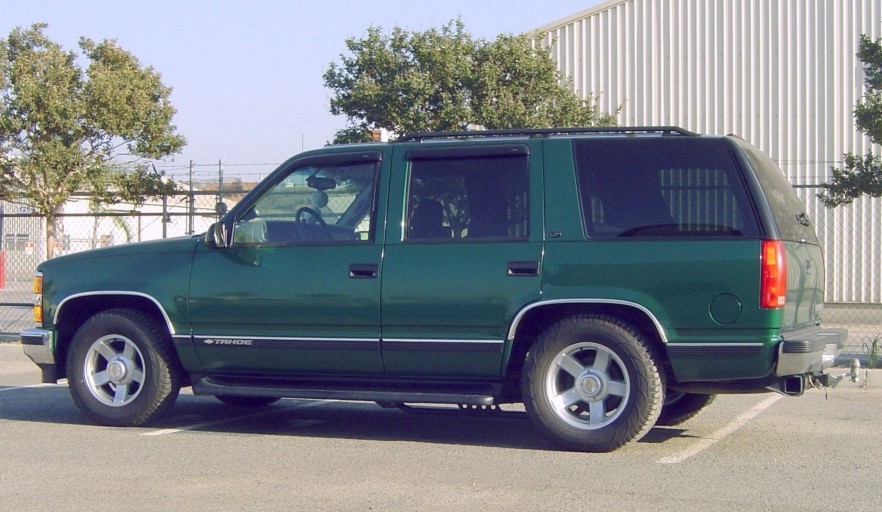
I run smaller rims AND tires on the front of my Tahoe with no problems with ABS or VSS.
Here's a picture:
You can cheat by setting up a fake rear end gear ratio but you have to manipulate everything just right so the speedometer stays correct.
For example, say you were programmed for 30" tires all the way around, have 3.42 gears, and swapped to a 28" up front and a 29" out back.
Stock this would be a total of 91929 pulses per mile with 3.42 gears and 30" tires. if you swap to 29" tires in the back the number of pulses per mile becomes 95076 pulses per mile, but that's for a 29" tire. Take that figure, make the tire diameter match whatever is on the front and then solve for the "virtual gear ratio" to make everything work.
Here's the math:
Start by finding out how many time the tire rotates in one mile:
D = Tire diameter
G = Gear Ratio
M = 5280 (feet in a mile)
P = Pulses per mile
pi = 3.14
T = Tire Revolutions per mile
T = M / ( ( D * pi ) / 12 )
so,
for 30" tire, 5280/((30*3.14)/12) = 672 revs per mile
for 29" tire, 5280/((29*3.14)/12) = 695 revs per mile
for 28" tire, 5280/((28*3.14)/12) = 720 revs per mile
The reluctor ring on the tailshaft has 40 segments meaning it pulses 40 times per revolution.
Therefore, P = G * T * 40
For the 30" tire and 3.42 gear combination mentioned above, 3.42*672*40 = 91929 Pulses per mile
For the 29" tire in the back it's 3.42*695*40 = 95076 Pulses per mile
Back to the example of 28" up front vs. 29" in the back, take the real pulses per mile figure for the rear tire and solve for the "fake" gear ratio using the "T" factor for the front tire:
G = P / 40 / T
95076/720/40 = 3.30
When programming the PCM use the pulses per mile number for the front tire and the real gear ratio. (98496 in this example) This will be off from the real number but the difference in gear ratio will correct it and ABS and traction control will function as they should.
Like any formula it gets more accurate the more decimals you choose to use for calculations and pi.
Get it?
I run smaller rims AND tires on the front of my Tahoe with no problems with ABS or VSS.
Here's a picture:
Last edited by James B.; Aug 3, 2005 at 09:04 AM.