


Magnuson Supercharger Tech Questions
 Nov 6, 2015 | 02:14 PM
#31


Joined: Jan 2006
Posts: 16,282
Likes: 438
From: Huntsville, AL

You need to know the pressure drop.
If you have none now your VE will not improve with a bigger/better/ported inlet. Improve the pressure drop 5% and VE will go up 5%.
You can relate it directly by the pressure before and after the inlet. Think of VE is how much of the possible air is it taking in per time or per rpm. A 2.3L blower should injest 2.3L of air every revolution. If the VE is 80% then its actually ingesting .8*2.3=1.84L which then falls back into the amount of air its moving based on the rotor speed.
I attached a spreadsheet I made a while ago when I was bored, you may find it fun to play with.
If you have none now your VE will not improve with a bigger/better/ported inlet. Improve the pressure drop 5% and VE will go up 5%.
You can relate it directly by the pressure before and after the inlet. Think of VE is how much of the possible air is it taking in per time or per rpm. A 2.3L blower should injest 2.3L of air every revolution. If the VE is 80% then its actually ingesting .8*2.3=1.84L which then falls back into the amount of air its moving based on the rotor speed.
I attached a spreadsheet I made a while ago when I was bored, you may find it fun to play with.
Last edited by Atomic; Nov 6, 2015 at 02:27 PM.
 Nov 6, 2015 | 02:55 PM
#33
Joined: Jan 2006
Posts: 16,282
Likes: 438
From: Huntsville, AL
See the second and third tabs...found a somewhat idea from a thread on the "internet". Don't know how much I trust it, but its something. Engine VE will change with boost in the real world, but airflow is ultimately limited by the blower VE. Boost will change with engine VE but not power.
Nov 6, 2015 | 03:06 PM
#34
So what it interesting is that the eaton max CFM as advertized is greater than the whipple max cfm as advertised by a decent margin.
The chart above puts the 2300 rotor pack above 1400 CFM at anything below 2.2 pressure ratio, and what appears like 1500 at 15PSI and 18k blower speed (recommended max), while whipple claims a max CFM from the 2.3 of 1389.
What doesn't make sense to me is the loss of boost with RPM. I understand why it happens with the way the engine and blower VE tables are shaped, but it is inconsistent with what I have seen. Without an outside issue, I have never seen this actually be the case with any PD blower.
The chart above puts the 2300 rotor pack above 1400 CFM at anything below 2.2 pressure ratio, and what appears like 1500 at 15PSI and 18k blower speed (recommended max), while whipple claims a max CFM from the 2.3 of 1389.
What doesn't make sense to me is the loss of boost with RPM. I understand why it happens with the way the engine and blower VE tables are shaped, but it is inconsistent with what I have seen. Without an outside issue, I have never seen this actually be the case with any PD blower.
Nov 6, 2015 | 03:21 PM
#35
Joined: Jan 2006
Posts: 16,282
Likes: 438
From: Huntsville, AL
On whipple's site they have different "2.3s", the 140R is 1389 but the 140AX is 1430cfm. If you want to be picky you need to know what speed that is at, if its at max speed (18000rpm) then it moves about the same as the eaton rotor set.
Who is saying they loose boost with RPM? That is consistent with belt slip or a super donkey dick cam (engine VE peaks while blower VE is falling). To gain boost with RPM usually means the cam is dying out pretty fast (barring all other possibilities like valve springs or exhaust pressure) before the blower does.
Who is saying they loose boost with RPM? That is consistent with belt slip or a super donkey dick cam (engine VE peaks while blower VE is falling). To gain boost with RPM usually means the cam is dying out pretty fast (barring all other possibilities like valve springs or exhaust pressure) before the blower does.
Nov 6, 2015 | 03:25 PM
#36
the spreadsheet is unless I'm missing something... Doesn't it?
with 370 CI, 2.3 blower, 8.25" crank diamater (thats up for debate as most OD have come back being closer to 8"), and a 2.833 blower pulley I see 16.1PSI at 2500 RPM and 14.6PSI at 7000 RPM with what is a fairly linear drop.
with 370 CI, 2.3 blower, 8.25" crank diamater (thats up for debate as most OD have come back being closer to 8"), and a 2.833 blower pulley I see 16.1PSI at 2500 RPM and 14.6PSI at 7000 RPM with what is a fairly linear drop.
Nov 6, 2015 | 03:34 PM
#37
Joined: Jan 2006
Posts: 16,282
Likes: 438
From: Huntsville, AL
Ah, gotcha. I would say that is related to the shape of the blower VE curve. Using that small of a pulley will overspeed the blower by ~5500rpm, fyi. It also shifts the VE way to the left so as blower VE is falling engine VE is rising so boost falls.
Feel free to mess with the green cells on the second tab, the stuff on the first tab will change automatically.
Feel free to mess with the green cells on the second tab, the stuff on the first tab will change automatically.
Nov 6, 2015 | 03:36 PM
#38

Also the VE is not consistent with what I have seen.
Apparently I never looked hard enough before...
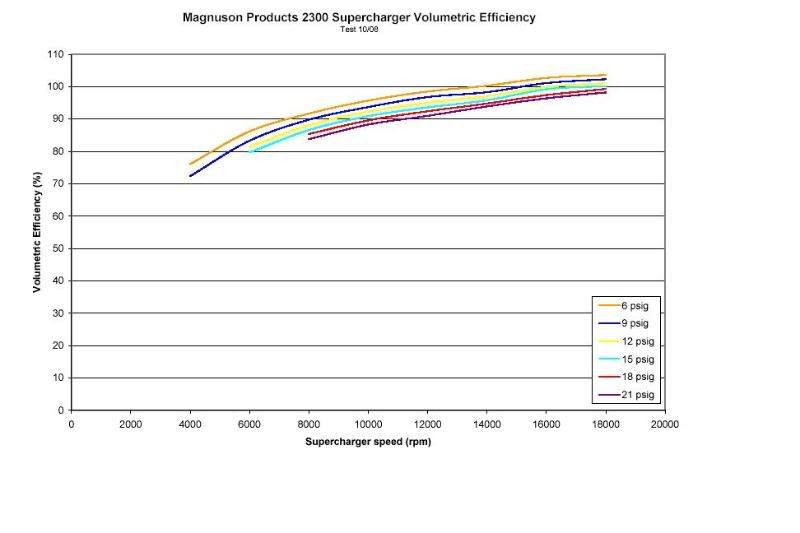


And the VE of the motor would likely change drastically on either end of the tq peak. Its no longer about how efficiently it can suck in air, but how efficiently it can receive air. The VE at the lower RPM range I would guess is far too low as the engine does not need to worry about creating intake velocity. Upper RPM range I am not sure... but something is up as I don't think boost will increase that dramatically above 6000 RPM.
Last edited by Vortec350ss; Nov 6, 2015 at 03:53 PM.
Nov 6, 2015 | 03:55 PM
#39
Joined: Jan 2006
Posts: 16,282
Likes: 438
From: Huntsville, AL
Feel free to change the second tab table VE values of my spreadsheet for whatever values you read off the graph. Also the third tab for the intercooler is pure SWAG (scientific wild *** guess). I am confident in the math in my spreadsheet. The curve inputs however could use some refining, so have at it and let me know what you find!