


SuperTurbo charged GMC
 May 17, 2010 | 08:45 PM
#61


 So now I gotta fix that. Our track is only open up here from mid May to Sept.
May 18, 2010 | 10:55 AM
So now I gotta fix that. Our track is only open up here from mid May to Sept.
May 18, 2010 | 10:55 AM
#62
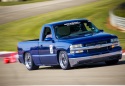


That's not really what I want to hear... I want about 700 or so rwhp out of blower only!  Supposed to be lighting guys with this blower on 5.4's in the 800's... :o/ I have the same drive train as you, Just a smaller motor and bigger truck. I've been low 12 with just a T70 turbo. Never had a good track day with just the big turbo. Best I ever ran with the compound setup was on 13psi and ran 12.6 @ 107 I think up here at altitude (4800', 6000+ DA) I want to be in the 11's easy, as a daily driver and not all striped down.
I want about 700 or so rwhp out of blower only! Supposed to be lighting guys with this blower on 5.4's in the 800's... :o/ I have the same drive train as you, Just a smaller motor and bigger truck. I've been low 12 with just a T70 turbo. Never had a good track day with just the big turbo. Best I ever ran with the compound setup was on 13psi and ran 12.6 @ 107 I think up here at altitude (4800', 6000+ DA) I want to be in the 11's easy, as a daily driver and not all striped down.
May 18, 2010 | 11:54 AM
#63
Not to hijack the thread, but I think you goals are realistic. Although I haven't put mine on a dyno, my track times and race weight calculate out to ~630whp on ~12psi in cool weather. Once I do the 8-rib conversion and pulley down to get plentum pressure above internal rotor compression (15psi), I am hoping to be close to that 700whp mark as well. I am interested to see what you can do with the KB if you decided to stay blower only.
There's nothing like that top end pull of a turbo that just keeps pulling harder the more you load it, but i also love the massive hit you get when you stab the gas on a PB blower,
 . I wish I could get both , but you seem to loose a lot of both when you compound, You just get the middle...
May 18, 2010 | 12:03 PM
. I wish I could get both , but you seem to loose a lot of both when you compound, You just get the middle...
May 18, 2010 | 12:03 PM
#64
I dont think you would have a problem even with the small blower. It seemed as the equation was literally multipling the two boosts and it was always close to what it was doing. like right now the 9lbs out of my blower I seruiosly think its only taking 1-1.5 lbs from the turbo to get 15. Ill have to get a gauge on the piping feeding the blower. I also must modify or figure something out on the elbow- if I cruise and roll into it with turbo boost its fine- if not the blower closes it at the blink of an eye because its faster than the turbo. Ill definetly update
The blower didn't have a problem taking a breath through that 3 1/2" tube and big old S475 turbo,  Never had any IAT problems with it either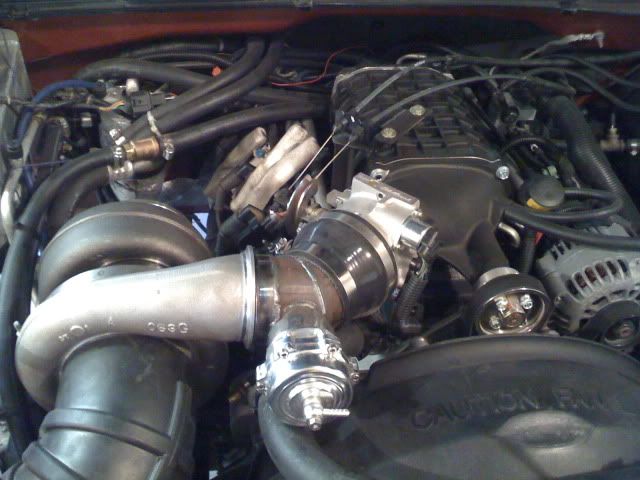
Last edited by kbracing96; May 18, 2010 at 12:08 PM.
May 18, 2010 | 12:41 PM
#65
That's good, I sent an email to Jeff at TPE, to see what he thinks of what I want, but haven't heard back. Seems like he's the KB GM guru,
There's nothing like that top end pull of a turbo that just keeps pulling harder the more you load it, but i also love the massive hit you get when you stab the gas on a PB blower,. I wish I could get both , but you seem to loose a lot of both when you compound, You just get the middle...
There's nothing like that top end pull of a turbo that just keeps pulling harder the more you load it, but i also love the massive hit you get when you stab the gas on a PB blower,
. I wish I could get both , but you seem to loose a lot of both when you compound, You just get the middle...Although I have never had a turbo setup, my KB feels equally as strong on the top end as it does low/mid.
May 18, 2010 | 01:10 PM
#66


I think your going to have to make a solid 90* bend on the elbow right before the TB, there is just a TON of vac on all the STS piping untill the turbo spools up. If you could find a way to have a BOV or something that would stay open till the turbo spooled and then shut, so the Blower could get a "breath" to spool the turbo, that would be ideal.
/\ This above is HUGE. I do remember reading on some VW/Audi specifications that they even have the B.O.V. set up to do this on their Turbo only set ups. It has an air pathway that it connects to upstream of the turbo inlet to supply with fresh filtered air. If I remember correctly it is programmed to switch from pass through (suck through) to closed (std. B.O.V. operation) based upon Throttle percentage, Manifold vacuum, and Mass Airflow. Essentially they're cutting down on "pumping losses" and increasing the efficiency in non-boost conditions, similar to what Magnuson's bypass valve does on the MP and TVS blowers. You could tie all this together I think with a controller that would also control the exhaust "cut out" bypass valve directing exhaust gasses around the exhaust turbine of the turbo that would otherwise cause over boost conditions.
You could program the BOV to be in "pass through mode" until sufficient pressure is present in the exhaust to create "boost" in the supercharger inlet piping. You could set the system up to read "supercharger inlet Pressure" which would be after the throttle body and compare it to "Turbo outlet Pressure". Create an algorithm in the controller that adjusts the BOV operation based on pressure differential of those two readings.
Last edited by ForcedTQ; May 18, 2010 at 01:19 PM.
May 18, 2010 | 03:52 PM
#67

Thread Starter
Teching In
Joined: Apr 2010
Posts: 30
Likes: 0
/\ This above is HUGE. I do remember reading on some VW/Audi specifications that they even have the B.O.V. set up to do this on their Turbo only set ups. It has an air pathway that it connects to upstream of the turbo inlet to supply with fresh filtered air. If I remember correctly it is programmed to switch from pass through (suck through) to closed (std. B.O.V. operation) based upon Throttle percentage, Manifold vacuum, and Mass Airflow. Essentially they're cutting down on "pumping losses" and increasing the efficiency in non-boost conditions, similar to what Magnuson's bypass valve does on the MP and TVS blowers. You could tie all this together I think with a controller that would also control the exhaust "cut out" bypass valve directing exhaust gasses around the exhaust turbine of the turbo that would otherwise cause over boost conditions.
You could program the BOV to be in "pass through mode" until sufficient pressure is present in the exhaust to create "boost" in the supercharger inlet piping. You could set the system up to read "supercharger inlet Pressure" which would be after the throttle body and compare it to "Turbo outlet Pressure". Create an algorithm in the controller that adjusts the BOV operation based on pressure differential of those two readings.
You could program the BOV to be in "pass through mode" until sufficient pressure is present in the exhaust to create "boost" in the supercharger inlet piping. You could set the system up to read "supercharger inlet Pressure" which would be after the throttle body and compare it to "Turbo outlet Pressure". Create an algorithm in the controller that adjusts the BOV operation based on pressure differential of those two readings.


 Jun 12, 2010 | 05:32 PM
#70
Thread Starter
Teching In
Joined: Apr 2010
Posts: 30
Likes: 0