


Mismatched combo. Undersized turbo. Where to go next.
 Jun 24, 2013 | 01:51 PM
#12


Joined: Jan 2006
Posts: 16,282
Likes: 438
From: Huntsville, AL

A turbo chokes when the velocity of the air leaving the compressor approaches sonic speeds (mach=1). When a fluid gets close to mach 1 you start getting shockwave formations which will result in a "choked flow" condition. No matter how much you raise the pressure the air speed will not increase. Which is why you just make a ton of hot air when the compressor is choked...you still have the losses of making the turbo operate at a higher pressure ratio but dont get the added benefit of more boost. If you look at a compressor map, you basically move horizontally from whatever PR you run at as the rpms increase. If you reach the right edge of the map, the choke line, you start moving up along the choke line as you try to spin the turbo harder.
The same thing happens with the hot side actually but super heated fluid like exhaust behaves a little differently and the speed of sound is much higher in hot fluid, so you dont run into that problem as easily.
If you have access to that turbos compressor map you can crunch some numbers and figure out about what engine rpm the compressor will be done, and hence where you need to shift.
The same thing happens with the hot side actually but super heated fluid like exhaust behaves a little differently and the speed of sound is much higher in hot fluid, so you dont run into that problem as easily.
If you have access to that turbos compressor map you can crunch some numbers and figure out about what engine rpm the compressor will be done, and hence where you need to shift.

 Jun 24, 2013 | 09:19 PM
#15
TECH Fanatic
iTrader: (2)
Joined: Oct 2006
Posts: 1,118
Likes: 0
From: slidell, LA
Right on Richard. OP, I actually have the 80mm version of that same turbo on my 5.3 and it's a monster. But dont underestimate the 69mm compressor. Ive seen that turbo make over 600rwhp on a 5.3, so your goal of over 400 on a 6.0 would be very easy. Like said, you probably wont want to spin it over 5800 rpm and you probably dont want to run more that 12-14 psi bc it will be out of compressor but it will make very stout low end and midrange torque
Jun 24, 2013 | 10:01 PM
#16
Thanks for all the responses guys. I found a compressor map for a mpgt45, which should be similar to mine. I'm going to see if I can educate myself on reading compressor maps. Then, compare a stock cam to my current one to see which one will be more beneficial for my setup based on the map. Seems like a logical way to base my camshaft choice, if I can do the math correctly.
Jun 24, 2013 | 11:23 PM
#17
A turbo chokes when the velocity of the air leaving the compressor approaches sonic speeds (mach=1). When a fluid gets close to mach 1 you start getting shockwave formations which will result in a "choked flow" condition. No matter how much you raise the pressure the air speed will not increase. Which is why you just make a ton of hot air when the compressor is choked...you still have the losses of making the turbo operate at a higher pressure ratio but dont get the added benefit of more boost. If you look at a compressor map, you basically move horizontally from whatever PR you run at as the rpms increase. If you reach the right edge of the map, the choke line, you start moving up along the choke line as you try to spin the turbo harder.
The same thing happens with the hot side actually but super heated fluid like exhaust behaves a little differently and the speed of sound is much higher in hot fluid, so you dont run into that problem as easily.
If you have access to that turbos compressor map you can crunch some numbers and figure out about what engine rpm the compressor will be done, and hence where you need to shift.
The same thing happens with the hot side actually but super heated fluid like exhaust behaves a little differently and the speed of sound is much higher in hot fluid, so you dont run into that problem as easily.
If you have access to that turbos compressor map you can crunch some numbers and figure out about what engine rpm the compressor will be done, and hence where you need to shift.
 Jun 25, 2013 | 01:23 PM
#19

A turbo chokes when the velocity of the air leaving the compressor approaches sonic speeds (mach=1). When a fluid gets close to mach 1 you start getting shockwave formations which will result in a "choked flow" condition. No matter how much you raise the pressure the air speed will not increase. Which is why you just make a ton of hot air when the compressor is choked...you still have the losses of making the turbo operate at a higher pressure ratio but dont get the added benefit of more boost. If you look at a compressor map, you basically move horizontally from whatever PR you run at as the rpms increase. If you reach the right edge of the map, the choke line, you start moving up along the choke line as you try to spin the turbo harder.
The same thing happens with the hot side actually but super heated fluid like exhaust behaves a little differently and the speed of sound is much higher in hot fluid, so you dont run into that problem as easily.
If you have access to that turbos compressor map you can crunch some numbers and figure out about what engine rpm the compressor will be done, and hence where you need to shift.
The same thing happens with the hot side actually but super heated fluid like exhaust behaves a little differently and the speed of sound is much higher in hot fluid, so you dont run into that problem as easily.
If you have access to that turbos compressor map you can crunch some numbers and figure out about what engine rpm the compressor will be done, and hence where you need to shift.

Kelsey- Sure some elements of your setup are not ‘optimal’ for a turbo charged application, but I’m willing to bet that it will still haul the mail. Taller gears will definitely help spool a turbo, but this is not that big of a deal since your turbo is slightly undersized. I would also imagine being geared lower would help make up for your lack of having a stall converter with that size cam. So unless you have the cash to redo your setup right now, I would tune the truck and enjoy it for the time being. A 500hp truck should be plenty of fun on the street with a quick spooling turbo.
 Jun 25, 2013 | 11:06 PM
#20
Made an attempt at plotting my setup on a compressor map
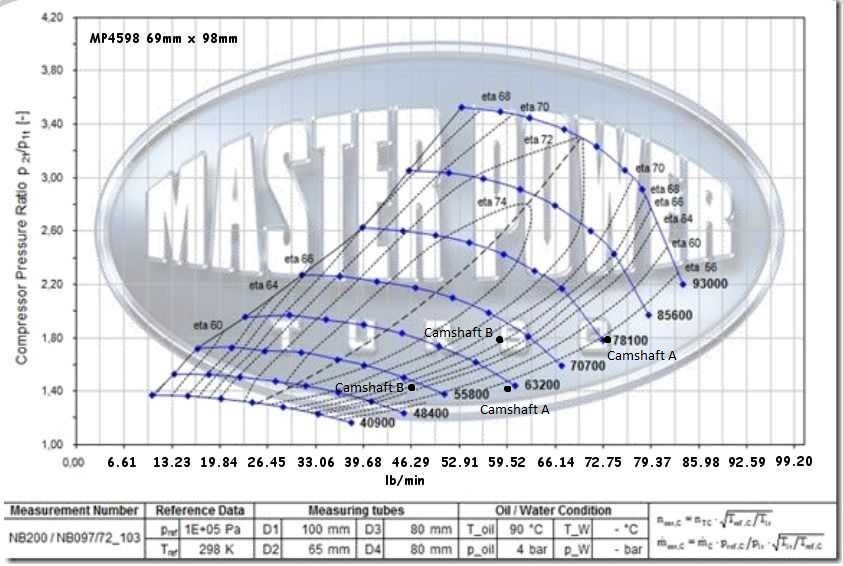
Camshaft A (current cam):
Calculated at 6500rpms and 85% volumetric efficiency. Converted to lbs/min by multiplying by .0691, which should relate to 120 degrees F.
Camshaft B (stock cam):
Calculated at 5800rpms and 75% volumetric efficiency. Converted the same way as above.
I graphed at a 1.48 pressure ratio (7psi) and a 1.82 pressure ratio (12psi). First attempt at getting data from a compressor map, so feel free to check my math. Looks like the stock cam/lower shift points fall into the compressor efficiency much better. Dont really know what else to make of the data though.

Camshaft A (current cam):
Calculated at 6500rpms and 85% volumetric efficiency. Converted to lbs/min by multiplying by .0691, which should relate to 120 degrees F.
Camshaft B (stock cam):
Calculated at 5800rpms and 75% volumetric efficiency. Converted the same way as above.
I graphed at a 1.48 pressure ratio (7psi) and a 1.82 pressure ratio (12psi). First attempt at getting data from a compressor map, so feel free to check my math. Looks like the stock cam/lower shift points fall into the compressor efficiency much better. Dont really know what else to make of the data though.