


Do all driveshafts on the K2XX explode?
 Dec 29, 2020 | 10:51 AM
#31


I was really happy when I called driveshaft specialist inc of texas. Good price and the guy knew what he was talking about. I called several other driveshaft shops and they wouldn't even have a conversation with me about critical speed, which is what causes these driveshafts to pop. They reach critical speed.
All the shops I called wanted to talk power handling. Our tin can drive shafts already handle quite a bit of power, they're 7 feet long though, so critical speed is.... critical lol
All the shops I called wanted to talk power handling. Our tin can drive shafts already handle quite a bit of power, they're 7 feet long though, so critical speed is.... critical lol
May 16, 2021 | 11:12 PM
#32
Teching In
Joined: May 2021
Posts: 2
Likes: 0
From: Southside
The vibration is ridiculous 115 and above there often surprised my driveshaft made it this long no dyno pulls I can totally see the drag of the drum/rollers stressing the shaft easily. I thought about getting the speed engineering loop seeing pictures of the failures given were it fails not sure it make a difference or minimizes damage. Kinda have a thing for 3rd/4th pulls especially with a cam you it’s really sad to think back when the limit was 99 a “glass half full”.
May 20, 2021 | 08:55 AM
#33

Teching In
Joined: Sep 2020
Posts: 42
Likes: 7
From: Texas Hill Country
I've been stewing this over and running some calcs and I can't see justifying spending money on a new larger driveshaft. In my scenario, that is. I have a '16 CCSB so it's the 143" wheelbase. It helps that I'm 4wd too because the driveshaft is shorter. My DS is 67" from u-joint to u-joint and diameter is 4.5". Using Spicer's calculator, I played around with these results: https://spicerparts.com/calculators/...rpm-calculator
I don't know the wall thickness, but based on carnage pics, it can't be that thick. Still, though, I ran the traps for a few scenarios:
Style D
OD x Wall Thickness = 4.54 x .083
1410 u joint
Critical Speed = 4550 RPM
Style D
OD x Wall Thickness = 4.5 x .154
1410 u joint
Critical Speed = 4459 RPM
Style D
OD x Wall Thickness = 4.54 x .259
1410 u joint
Critical Speed = 4337 RPM
Then, I used an Engine RPM calculator and GPS verified RPM @ any given speed.
All in all, near as I can tell, the critical 'ground' speed would be anywhere between 123-130 MPH.
Maybe I just got lucky and got the best factory combination?
I don't know the wall thickness, but based on carnage pics, it can't be that thick. Still, though, I ran the traps for a few scenarios:
Style D
OD x Wall Thickness = 4.54 x .083
1410 u joint
Critical Speed = 4550 RPM
Style D
OD x Wall Thickness = 4.5 x .154
1410 u joint
Critical Speed = 4459 RPM
Style D
OD x Wall Thickness = 4.54 x .259
1410 u joint
Critical Speed = 4337 RPM
Then, I used an Engine RPM calculator and GPS verified RPM @ any given speed.
All in all, near as I can tell, the critical 'ground' speed would be anywhere between 123-130 MPH.
Maybe I just got lucky and got the best factory combination?
May 21, 2021 | 01:13 AM
#34

On The Tree


Joined: Jun 2017
Posts: 138
Likes: 40
From: DFW
I've been stewing this over and running some calcs and I can't see justifying spending money on a new larger driveshaft. In my scenario, that is. I have a '16 CCSB so it's the 143" wheelbase. It helps that I'm 4wd too because the driveshaft is shorter. My DS is 67" from u-joint to u-joint and diameter is 4.5". Using Spicer's calculator, I played around with these results: https://spicerparts.com/calculators/...rpm-calculator
I don't know the wall thickness, but based on carnage pics, it can't be that thick. Still, though, I ran the traps for a few scenarios:
Style D
OD x Wall Thickness = 4.54 x .083
1410 u joint
Critical Speed = 4550 RPM
Style D
OD x Wall Thickness = 4.5 x .154
1410 u joint
Critical Speed = 4459 RPM
Style D
OD x Wall Thickness = 4.54 x .259
1410 u joint
Critical Speed = 4337 RPM
Then, I used an Engine RPM calculator and GPS verified RPM @ any given speed.
All in all, near as I can tell, the critical 'ground' speed would be anywhere between 123-130 MPH.
Maybe I just got lucky and got the best factory combination?
I don't know the wall thickness, but based on carnage pics, it can't be that thick. Still, though, I ran the traps for a few scenarios:
Style D
OD x Wall Thickness = 4.54 x .083
1410 u joint
Critical Speed = 4550 RPM
Style D
OD x Wall Thickness = 4.5 x .154
1410 u joint
Critical Speed = 4459 RPM
Style D
OD x Wall Thickness = 4.54 x .259
1410 u joint
Critical Speed = 4337 RPM
Then, I used an Engine RPM calculator and GPS verified RPM @ any given speed.
All in all, near as I can tell, the critical 'ground' speed would be anywhere between 123-130 MPH.
Maybe I just got lucky and got the best factory combination?
you have 1410 u joint?
i thought they were all 1355... that is what i have on my burb.
& per GM spec site... it mentions Sierra, Silverado & SUVs
also thickness is listed as 0.075.
that & the cheaper 1355 u joints, along w/ cheapest bid supplier ... make it worth the upgrade
from a qik google search a coke can has a wall thickness of 0.097"
so , anything getting into triple digit speeds is generally on borrowed time if running OEM driveshaft.
although some people are lucky for a long while

i've seen quite a few vids. even saw one in-person, let go on a dyno (they were running in 3rd gear. it let go around 106-110)
they had a loop installed & it saved the truck
most good aftermarket shafts arent all that expensive ($500-800 avg) & worth piece of mind.
unless you want carbon fiber... those are pricey
May 21, 2021 | 08:22 AM
#35
Teching In
Joined: Sep 2020
Posts: 42
Likes: 7
From: Texas Hill Country
@gat0r it's actually a 1415 AAM joint, which is very similar to the 1410. It's like 7 or 8 thousandths narrower. Depending on cab/engine/drivetrain combo you could have a lot of different UJs. It's a mess honestly.
A coke can is .0102 so it isn't quite comparable. I've actually had Driveshaft Specialist here in SA build me a DS before and I called them up on the topic. Thicker wall alone actually reduces critical speed (as shown above in my calcs) it has to be combined with increasing diameter to make a substantive change. He said the only benefit over my current DS is power handling, unless I was chasing that last few MPH. And he also confirmed it's a 1415 UJ. Though he seems to think it's cross-compatible with 1410, which is a heated debate in and of itself. I'd rather go with the correct UJ.
Therefore, I bought two Spicer 5-3207X UJs off eBay for $55 shipped and will be taking them and my DS to Driveshaft Specialist next month to have them replace and balance while I'm out of town. I'll then run it up to 125 MPH and see what happens. JK
A coke can is .0102 so it isn't quite comparable. I've actually had Driveshaft Specialist here in SA build me a DS before and I called them up on the topic. Thicker wall alone actually reduces critical speed (as shown above in my calcs) it has to be combined with increasing diameter to make a substantive change. He said the only benefit over my current DS is power handling, unless I was chasing that last few MPH. And he also confirmed it's a 1415 UJ. Though he seems to think it's cross-compatible with 1410, which is a heated debate in and of itself. I'd rather go with the correct UJ.
Therefore, I bought two Spicer 5-3207X UJs off eBay for $55 shipped and will be taking them and my DS to Driveshaft Specialist next month to have them replace and balance while I'm out of town. I'll then run it up to 125 MPH and see what happens. JK
Jun 14, 2021 | 09:23 PM
#37
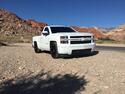


Had mine let go last year at about 120. Not sure how fast it was spinning with 4.10 gears on a 32” tire but it was scary as hell. Got lucky that front half only hit my Viking shock and vapor canister on its way out. Back half wedged itself up between bed and muffler. Had a 3.5” chromoly one piece made up to hopefully not happen again.

 Jun 15, 2021 | 11:22 AM
#40
On The Tree
Joined: Jun 2017
Posts: 138
Likes: 40
From: DFW
its called tube deadener, i think
manufacturers have been doing it for decades.
a buddy cut open a DS from an 85 K5 blazer, been in his family since they bought it. it had cardboard in it
basically sound deadening. w/o it certain length/diameter driveshafts can "ring."
its usually glued in to keep it indexed